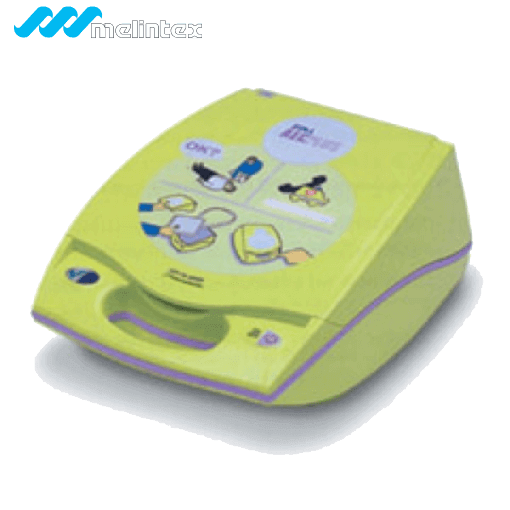
ZOLL AED Plus
$2,725.00

When a cardiac arrest occurs, the fact is that only half of the victims will need a shock. The other half requires cardiopulmonary resuscitation (CPR).
AED Plus® responds in the following circumstances :
Not pushing hard enough? It will tell you when to push harder.
Pushing hard enough? It will say, “Good compressions.”
Not pushing fast enough? A metronome will lead you right.
It will even show you the depth of each compression. In real time.
Not yet started? The AED Plus will tell you again to get started.
Compressions stopped? It will tell you to continue.
CPR Feedback
ZOLL believes an AED should not just deliver a shock. It should also help the rescuer provide high-quality cardiopulmonary resuscitation (CPR). AED Plus with Real CPR Help offers :
Real CPR Help for rate and depth of compressions.
Support for the complete Chain of Survival.
Help to all victims of Sudden Cardiac Arrest, even those for which no shock is advised.
Zoll’s one-piece electrode pad provides fast and accurate placement.
Consumer lithium camera batteries available from retail stores
Everything You Need For The Rescue
The CPR-D•padz comes complete with a CPR barrier mask, scissors, disposable gloves, a prep razor, a towel, and a moist towelette.
 DOWNLOAD
The 2010 American Heart Association Guidelines for Cardiopulmonary Resuscitation (CPR) and Emergency Cardiovascular Care make it clear—in most emergencies, the quality of CPR provided by the rescuer can make the difference between life and death. Yet, even trained professionals often do not perform CPR optimally and can benefit significantly from monitoring and support. A study by Abella et al. shows that audiovisual CPR feedback improves the quality of chest compressions delivered by health care providers.1
Cardiopulmonary Resuscitation (CPR) Feedback Technology
ZOLL AED Plus was the first to introduce technology to help improve CPR performance in 2002, and Real CPR Help is now a standard feature on all ZOLL AEDs and defibrillators. This gives rescuers the best real-time CPR feedback and the confidence that they are providing the best cardiopulmonary resuscitation (CPR) possible.
How Real CPR Help Works
With ZOLL technology, rescuers receive the following CPR feedback and prompting for help in providing effective manual CPR.
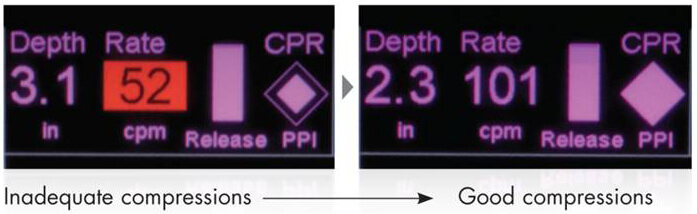 CPR Dashboard™ featuring Real CPR Help drives high-quality CPR on the R Series®
- Compression Depth Indicator - to achieve at least a two-inch compression depth, which is critical for high-quality CPR, as detailed in the 2010 American Heart Association (AHA) Guidelines.
- Compression Rate Indicator - to achieve the recommended compression rate of 100 compressions per minute through a metronome beep that is easy to follow.
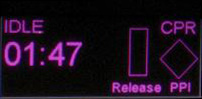
- Release Bar – measures release velocity to determine that rescuers are allowing sufficient time for cardiac filling.
- Perfusion Performance Indicator (PPI) – integrates compression depth, rate, and interruption times into one visual indicator. Maintaining maximum value (full indicator) provides visual indication of performance to AHA Guidelines.
- Audio/Message Prompting: Voice and message feedback such as “PUSH HARDER” helps accomplish quality compressions quickly, resulting in a reinforcing message, “GOOD COMPRESSIONS.” To minimize CPR idle time, “CONTINUE CPR” is another important feedback reminder.
- Idle Timer - raises awareness of CPR interruptions by displaying the elapsed time from when the last compression was delivered.
 Idle timer
Code Data Transmission: All of our product lines have the capability to transmit CPR data, making complete resuscitation review and playback easy.
Example of post-code CPR data from the R Series defibrillator
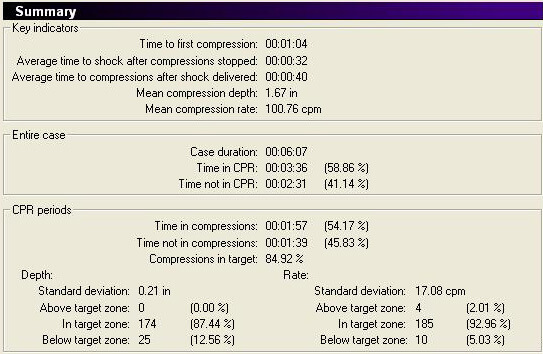 Post-code CPR data
Real CPR Help is accomplished with our quick and easy to apply OneStep™ Electrode Pads, CPR-D-padz®, and CPR Stat-padz. There is no compromise to code readiness with cumbersome extra electrodes to manage and position on the patient before you get valuable CPR data.
1Abella B. et. al. “CPR quality improvement during in-hospital cardiac arrest using a real-time audiovisual feedback system”, Resuscitation, 2007;73:54-61.